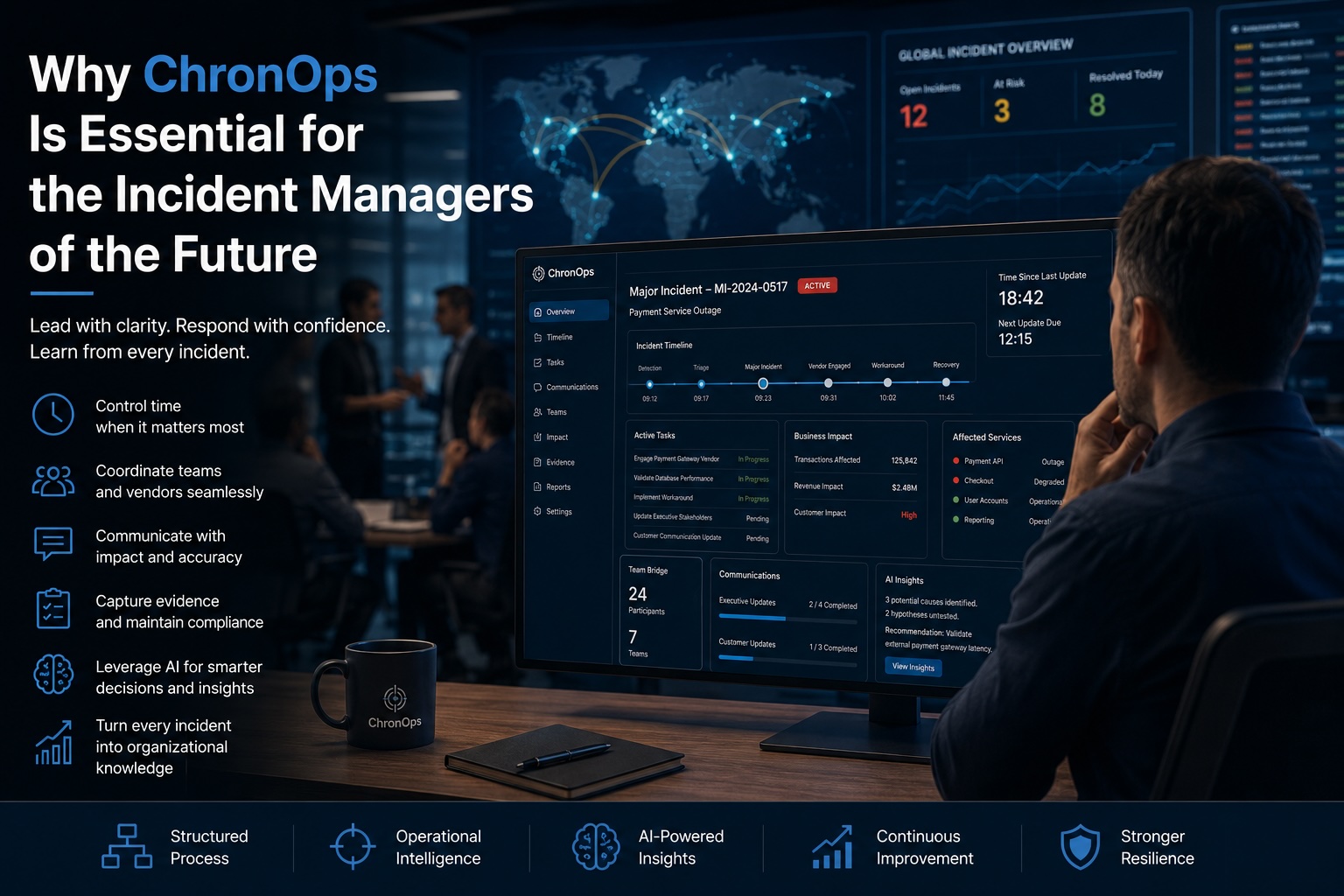
Incident Management Has Changed. The Tools Have Not.
Twenty years ago, a critical IT incident usually meant a failed server, a database outage, or a network disruption inside a company’s own data centre. The Incident Manager’s job was primarily technical: gather experts, identify the fault, restore the service, and document the outcome.
Today’s reality is dramatically different.
A single production outage may involve:
- Multiple cloud providers
- SaaS platforms
- Third-party vendors
- API ecosystems
- Security operations
- Regulatory reporting
- Executive stakeholders
- Customer communications
- AI-assisted troubleshooting
Meanwhile, every minute of downtime carries increasing financial, operational, and reputational costs.
Despite this evolution, many organisations still expect Incident Managers to coordinate these complex events using little more than an ITSM ticket, Microsoft Teams, email, spreadsheets, and handwritten notes.
This approach no longer scales.
The future of Incident Management demands something fundamentally different.
It demands operational intelligence.
It demands structure.
It demands ChronOps.
The Incident Manager Is Becoming an Operational Conductor
The Incident Manager of the future is no longer expected to be the most technically knowledgeable person in the room.
Instead, they become the conductor of a highly specialised orchestra.
During a critical incident they must simultaneously:
- coordinate technical teams
- engage vendors
- communicate with executives
- maintain timelines
- ensure evidence collection
- monitor business impact
- control communications
- prevent duplicated work
- prepare audit evidence
- support post-incident review
None of these activities directly restore the service.
Yet every one of them determines whether the incident becomes controlled—or chaotic.
ChronOps was designed specifically for this role.
Moving Beyond Ticket Management
Traditional ITSM tools focus on recording work.
ChronOps focuses on managing the incident itself.
A ticket answers questions such as:
- Who owns this issue?
- What is its priority?
- What changes were made?
ChronOps answers completely different questions:
- What should happen next?
- Who should be engaged now?
- Which communication is due?
- What evidence is still missing?
- Which teams have not yet responded?
- How much time has passed since the last executive update?
- Are we following our own Major Incident process?
These questions define successful incident leadership.
ChronOps transforms incident response from passive documentation into an actively managed operational workflow.
Time Is the Most Valuable Resource During an Incident
Every experienced Incident Manager has experienced the same phenomenon.
The first ten minutes feel like one hour.
The next hour disappears in moments.
People forget:
- who joined the bridge
- what was already tested
- when management was updated
- whether legal has been informed
- which vendor owns the current action
- who approved the workaround
Memory becomes unreliable under pressure.
ChronOps introduces operational timing into every stage of incident response.
Instead of relying on memory, the platform continuously guides the Incident Manager through predefined operational phases while recording every significant event.
Time stops being something to chase.
It becomes something to control.
AI Should Support Decisions – Not Replace Them
Artificial Intelligence is becoming a standard component of enterprise operations.
However, AI cannot make reliable recommendations if the information provided is incomplete, inconsistent, or scattered across dozens of systems.
ChronOps was designed around structured operational data.
Evidence.
Communications.
Actions.
Escalations.
Business impact.
Timelines.
Decision logs.
Every activity becomes structured context for AI assistance.
Instead of asking an AI model:
“Can you summarise this Teams chat?”
ChronOps enables much richer questions:
- What hypotheses remain untested?
- Which evidence contradicts our current assumption?
- Which stakeholders have not yet been updated?
- Which vendor is delaying restoration?
- Generate the next executive update.
- Draft the Post Incident Review.
- Produce the Root Cause Analysis report.
AI becomes a decision-support partner instead of a chatbot.
Every Incident Creates Knowledge
One of the greatest weaknesses of traditional incident response is that knowledge disappears after resolution.
Lessons learned become Word documents.
Meeting recordings are forgotten.
Bridge chat histories disappear.
Screenshots remain on personal desktops.
The next Incident Manager starts again from zero.
ChronOps continuously builds organisational knowledge.
Every incident contributes:
- investigation paths
- successful remediation techniques
- communication history
- vendor performance
- timeline analytics
- evidence libraries
- AI learning context
The organisation becomes progressively better prepared with every incident.
Standardisation Without Losing Flexibility
Every organisation responds to incidents differently.
Financial institutions have different obligations than airlines.
Healthcare differs from manufacturing.
Government differs from software companies.
ChronOps does not force organisations into one methodology.
Instead, it provides structured operational frameworks that organisations can customise.
Incident phases.
Communication cadence.
Escalation matrices.
Approval workflows.
Evidence requirements.
Executive reporting.
The framework remains consistent while the operational process reflects each organisation’s own governance.
Incident Managers Deserve Better Tools
Many organisations invest millions in monitoring platforms.
Security platforms.
Observability.
Automation.
Cloud infrastructure.
Yet the individual responsible for coordinating the entire response often works with:
- Teams
- Outlook
- Excel
- Sticky notes
- Whiteboards
- Memory
ChronOps fills the missing operational layer.
It does not replace ITSM.
It does not replace monitoring.
It does not replace collaboration platforms.
It connects them into a structured operational command centre designed specifically for Incident Management.
Preparing for the Autonomous Operations Era
The future will not eliminate Incident Managers.
It will elevate them.
Automation will restart services.
AI agents will analyse logs.
Monitoring platforms will detect anomalies.
But someone will still need to coordinate people, assess business risk, approve decisions, communicate with executives, and maintain overall control of the incident.
ChronOps is designed for this future.
As AI handles more technical analysis, the Incident Manager’s role becomes increasingly focused on operational leadership.
ChronOps provides the structure, intelligence, and visibility needed to lead confidently in that environment.
The Future of Incident Management Is Operational Intelligence
Critical incidents are no longer isolated technical failures.
They are business events.
Every major outage affects customers, employees, revenue, compliance, reputation, and executive confidence.
Managing these events requires more than ticketing.
It requires visibility.
Structure.
Discipline.
Evidence.
Timing.
Communication.
Intelligence.
ChronOps was built on a simple belief:
The best Incident Managers should spend their time leading the response – not fighting the process.
By transforming major incident management into a guided, measurable, AI-enhanced operational discipline, ChronOps empowers organisations to respond faster, communicate better, learn continuously, and build resilience for the challenges ahead.
The future of Incident Management is not simply faster.
It is smarter.
It is structured.
It is ChronOps.
Leave a Reply